The Stochastic Entanglement Theory.
The Stochastic Entanglement Theory (SET) for the pathogenesis of Phantom Limb Pain (PLP) was introduced by Prof. Max Ortiz Catalán in 2018 as a scientific hypothesis to explain how a person can experience pain in a limb that is no longer physically present.
What is it?
Definition, mechanism and the core clinical prediction.
Read →02Premises
Scope, premises and core elements of the theory.
Read →03Get it?
The theory explained through everyday analogies.
Read →04What’s new?
From periphery, to cortex, to network.
Read →05Through different lenses
Mechanistic, computational, clinical and integrative views.
Read →06Common misconceptions
Clearing up terms used throughout the PLP literature.
Read →Pain from silent circuits.
A scientific hypothesis with testable predictions, grounded in neural dynamics.
It was formulated as a scientific hypothesis with testable predictions, and accounts for modern clinical findings in a way previous ideas could not. Grounded in neural dynamics, the SEH regards the central nervous system as a dynamical system in which random neural activity (stochastic), always present but normally harmless, plays a defining role. The SEH is not only a theoretical account, it has direct practical implications for the prevention and treatment of PLP described here.
This page is based on the original article published in Frontiers in Neurology in 2018 (Ortiz-Catalan, Frontiers in Neurology, 2018), and subsequent practical treatment implications published in the Journal of NeuroEngineering and Rehabilitation in 2026 (Ortiz-Catalan, JNER, 2026).
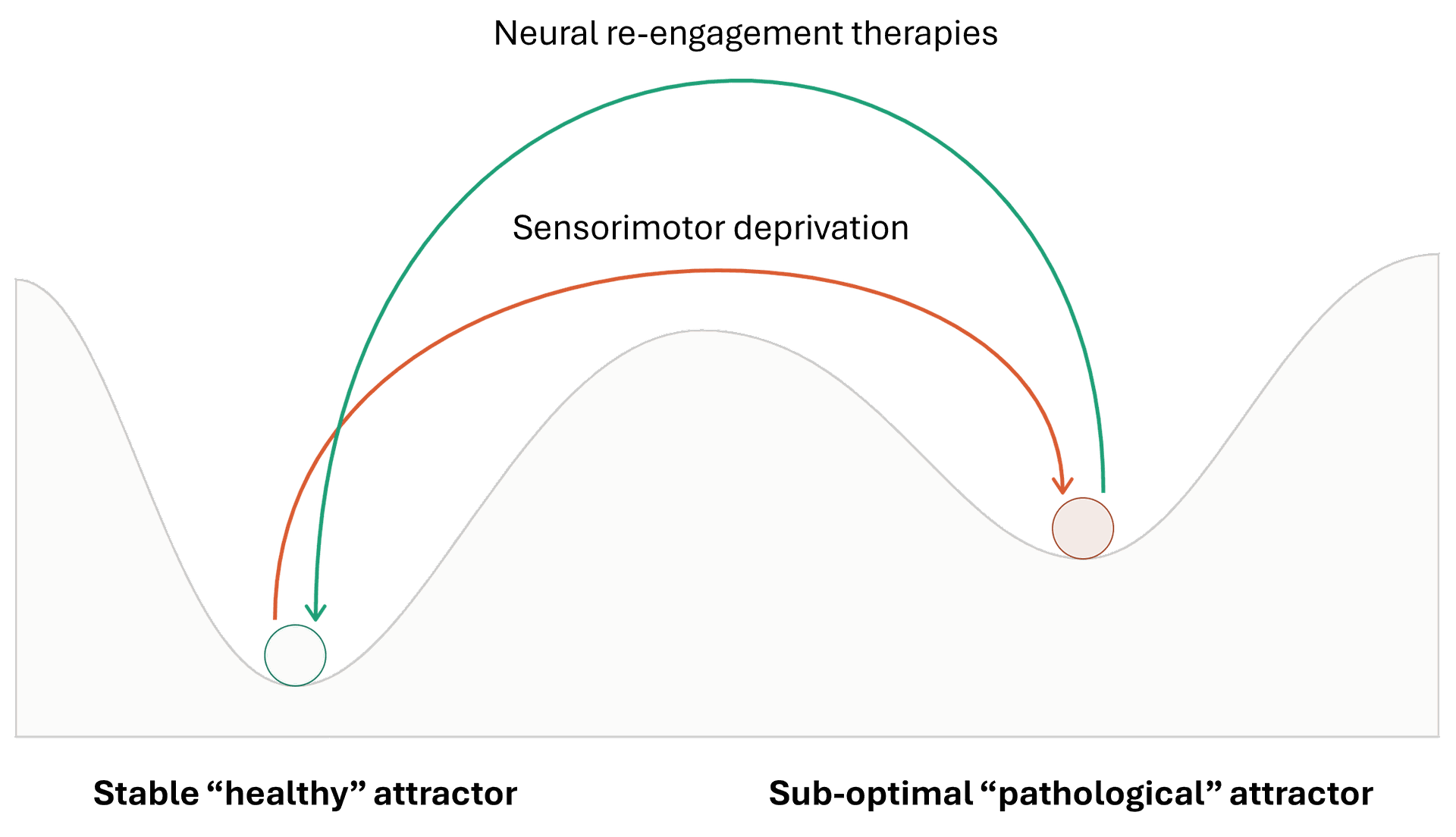
Figure 1Schematic dynamical systems illustration of the Stochastic Entanglement Theory (SET). The stable attractor represents a sensorimotor circuit under structured, high-dimensional engagement. The sub-optimal attractor represents the same circuit after amputation induced somatosensory and motor deprivation, when low-dimensional, noise-susceptible activity permits stochastic co-activation with nociceptive circuits to consolidate into a persistent maladaptive coupling. The red arrow denotes this sensorimotor deprivation driven transition. The green arrow denotes the reverse transition predicted for neural re-engagement therapies, such as targeted never transfer surgical procedures (e.g., TMR, TSR, RPNIs) and non-invasive motor training approaches (e.g., PME, PMT).
After an amputation, the neural resources that once controlled and sensed the missing limb do not disappear. They lose the structured activity that occupied them. Noise is often present in the nervous system and is normally inconsequential, but with little structured activity left to compete with it, spontaneous firing in these circuits can trigger activity in pain processing circuits. Any such event can itself be felt as pain, and each one can strengthen the pathological coupling between the two circuits. Because what triggers them is random, the pain episodes can come and go, and the same randomness accounts for why PLP affects some people and not others, appears immediately in some cases and only years later in others, and varies so widely in quality and intensity.
The SET makes a direct clinical prediction. If pain follows from circuits dramatically loosing their structured activity, then returning those circuits to purposeful use should prevent the coupling from forming, and weaken it once formed. This is the basis of therapies for PLP such as Phantom Motor Execution (PME), Progressive Motor Training (PMT), and an improved version of Mirror Therapy prioritizing motor training over anthropomorphic visual feedback.
Most existing accounts of PLP do not hold up to currently available clinical evidence and often describe neural changes that accompany PLP without explaining how those changes produce pain. The theoretical framework of stochastic entanglement was introduced to close that gap.
The SET is not a theory of cortical maps, it does not depend on visual illusions, and it does not rest on prediction errors.
What the theory addresses.
Neuropathic phantom limb pain: pain perceived in the missing limb without stimulation of nociceptive fibers.
The Stochastic Entanglement Theory (SET) addresses neuropathic phantom limb pain, that is, pain perceived in the missing limb that arises without stimulation of nociceptive fibers. It does not attempt to explain pain that is nociceptive in origin (peripheral), such as pain driven by a neuroma, by infection, or by other stimulation of the nerve endings that once served the limb. These are distinct conditions with distinct mechanisms, and they call for distinct treatments. Where such a nociceptive source is present, it should be identified and addressed on its own terms, and its resolution should not be expected from interventions aimed at the maladaptive process the SET concerns (Ortiz-Catalan, Frontiers in Neurology, 2018).
Within the neuropathic classification, the mechanism the SET proposes has a nociplastic character. Nociplastic pain, in the terminology adopted by the International Association for the Study of Pain (IASP), arises from altered nociception without ongoing tissue damage or a clear nociceptive source. Phantom limb pain is normally classified as neuropathic because it follows a definite lesion of the somatosensory system (the amputation). Yet under the SET, the pain is not sustained by that lesion. It arises from altered dynamics in circuits that remain structurally intact, which is closer to the nociplastic description than to a pain driven by the lesion itself. In this sense the SET locates the origin of PLP in how intact circuits behave, not in the damage that set the condition in motion.
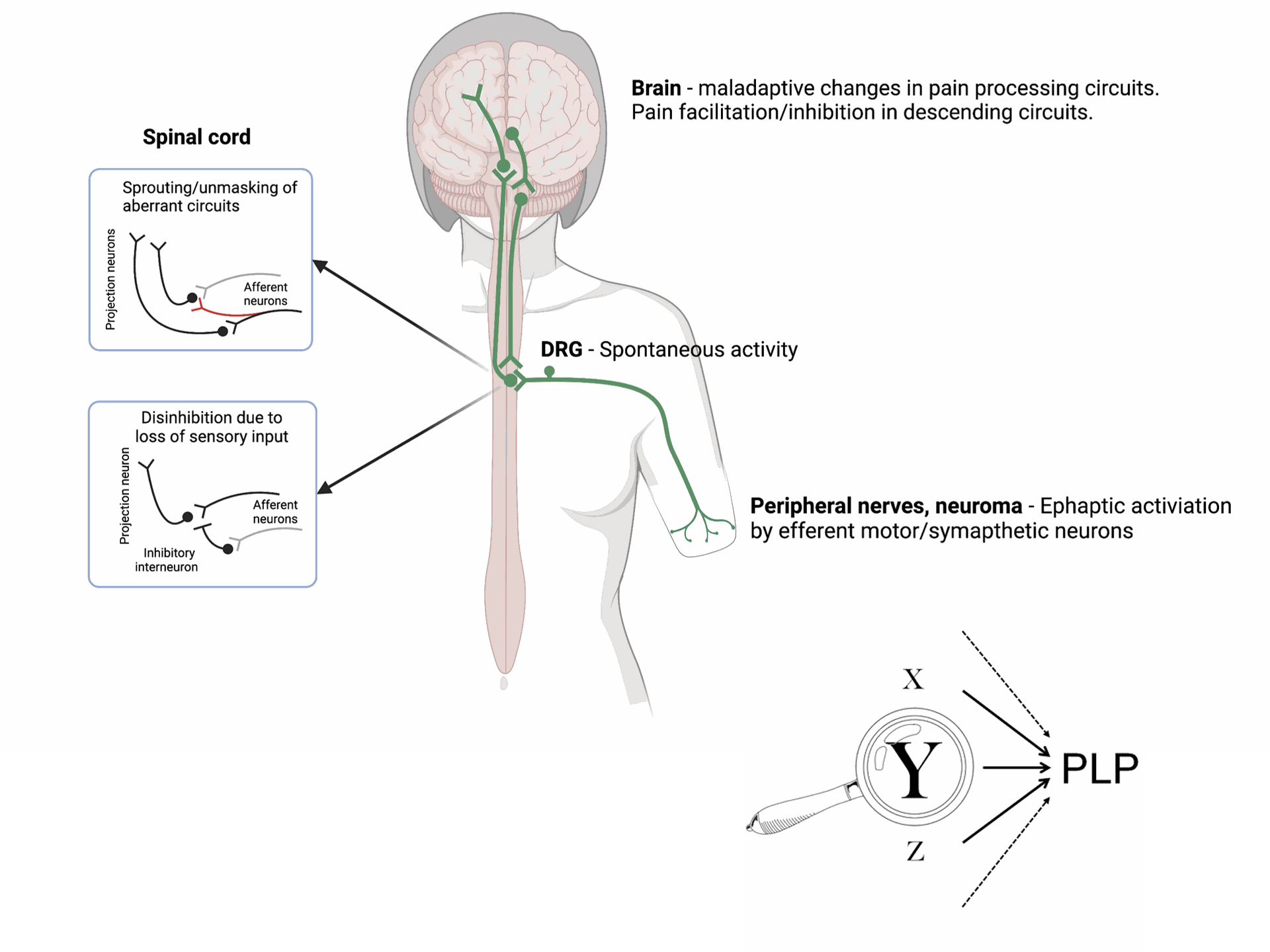
The SET premises and core elements.
Premises
- There exists pain processing neural circuitry (it generates the experience of pain in our limbs).
- There exists sensorimotor processing circuitry (it allows us to feel and control our limbs).
- These two are inherently related. They are already linked in conventional pain (nociceptive pain), which is why a noxious stimulus is felt in a specific part of the body. In health, this link stays selective to genuine noxious stimuli (stimuli potentially tissue damaging).
- Individual neurons do not always fire deterministically, but sometimes stochastically (randomly).
Before amputation (stable healthy attractor)
- The nervous system as a whole sits in a stable state, a healthy attractor (Figure 1).
- Random, spurious firing has little effect, because structured activity dominates it and holds it in check.
After amputation (sub-optimal pathological attractor )
- The sensorimotor circuitry that served the missing limb loses most of its normal structured activity.
- With little structured activity left to dominate it, the same random firing is no longer held in check. Firing in these circuits can now coincide with, or trigger, activity in pain processing circuitry, and this can be felt as pain.
- Each such co-activation can strengthen the coupling between the two circuits, by the ordinary rule that neurons active together strengthen their connection. Repeated often enough, this draws the system toward a pathological attractor, a sub-optimal quasi-stable state that can sustain pain on its own (Figure 1).
- Because the circuitry involved runs the length of the neural axis, this entanglement can take place anywhere from peripheral nerve to cortex, not only in the cortex.
Recovery
- The same rule that forms the coupling can weaken it. Connections strengthened by activity together are weakened when one fires without the other.
- Returning the deprived circuitry to structured use restores the activity that dominates the noise, and drives the two circuits apart rather than together.
- As the coupling weakens, the system is drawn back toward a stable state, and pain is prevented from forming or subsides once formed. This is the basis of the treatments derived from the SET.
The SET through analogies.
Useful but imperfect by definition: an introduction to the framework, not the ground truth.
Disclaimer: Analogies can be useful but imperfect by definition, therefore should not be used as the ground truth but as introduction to the theoretical framework of stochastic entanglement.
The "No Job, No Good" analogy
Feeling and controlling our limbs with dexterity takes a good chunk of the activity in the brain and nervous system, which means that there is a large number of neurons devoted to this one job. After an amputation, those neurons lose their job, because there is no longer a limb to feel or control. And this is no small number, just think about how long it took you to learn to walk or use your hands properly. We all know that being jobless leads nowhere good. Neurons fire now and then even with nothing to do, and normally this goes unnoticed when all the others are busy working. But with so many of them now out of work, every so often that stray firing gets noticed by the pain system and is felt as pain in the limb that is gone. What we need to do is give them a job back, so they stop messing around with pain.
The "room goes quiet" analogy
Picture yourself at a crowded party. Everyone is talking at once, the room is loud, and if you happen to say something silly it goes unnoticed, lost in all the noise. Now imagine the room suddenly falls quiet, many conversations stop at the same time. That same silly comment is now heard across the room.
Something similar happens after an amputation. The random firing of neurons was always there, but it went unnoticed while the rest of the system was busy and loud feeling and controlling the limb. When a large part of that activity falls silent, that same random firing can now be heard by the pain system and felt as pain in the missing limb.
From periphery, to cortex, to network.
The SET in historical context.
Early efforts to understand PLP sought its cause in the periphery. Attention focused on the residual limb, the severed nerves, and the neuromas, on the assumption that pain felt in a limb that was gone must originate in what remained of it. The earliest treatments followed this logic, targeting the residual limb and the severed nerves, but they largely failed to relieve chronic pain, and the assumption that the periphery held the answer began to weaken.
The seminal work of Flor and colleagues moved the focus decisively to the brain. Their finding that PLP correlated with reorganization of the sensorimotor cortex shifted the field's attention from the periphery to the cortex, and cortical reorganization became the dominant framework to try to understand the condition. This was a major shift in focus, and carried the attention from one extreme to the other, from the residual limb to the cortex, as though the origin of the pain had to lie at one pole or the other.
The Stochastic Entanglement Theory declines that choice. Rather than relocating the cause from the periphery to the cortex, it proposes that PLP arises from the dynamics of neural networks across the entire neural axis, from peripheral nerve to spinal cord to brain. The question is no longer where along the body the pain begins, but how deprived circuits behave wherever they are. In this sense SET does not swing the pendulum back, nor does it settle between the two poles. It reframes the problem as one of network dynamics rather than anatomical location, and in doing so it accommodates the peripheral and cortical findings as parts of a single account rather than as rival explanations.
The SET through different lenses.
The same theory formulated from mechanistic, functional, computational, clinical and integrative angles.
A. Concise formulation
The Stochastic Entanglement Theory posits that phantom limb pain emerges from random and maladaptive coupling between neurons in underutilized somatosensory and motor circuits, and those involved in pain processing. When normal sensorimotor function is lost, disuse-driven neural activity can produce spurious associations that manifest as pain.
B. Physiological angle
The Stochastic Entanglement Theory proposes that phantom limb pain arises when spontaneous activity within disused somatosensory and motor circuits, under conditions of neural deprivation, leads to maladaptive coupling with nociceptive networks. Under considerable sensorimotor depravation, random neural activations within the sensorimotor system can recruit pain-processing neurons, generating pain even in the absence of peripheral input.
C. Dynamical systems angle
The Stochastic Entanglement Theory proposes that phantom limb pain results from stochastic (random), maladaptive coupling between disused sensorimotor circuits and nociceptive pathways. Loss of sensory signaling and motor activity after amputation destabilizes these networks, pushing them out of their stable state in dynamical systems terms, and spontaneous co-activations between pain-related and sensorimotor-related neural populations can entangle them in a sub-optimal state.
According to the Stochastic Entanglement Theory, phantom limb pain results from stochastic activations between the pain and somatosensory–motor pathways throughout the neural axis (from peripheral nerves to cortex) when these networks are no longer engaged in coherent limb control. Under conditions of deprivation, spontaneous co-activations between pain- and sensorimotor-related neurons can become pathologically linked, giving rise to pain.
The Stochastic Entanglement Theory attributes phantom limb pain to the consequences dramatic disuse of the limb’s sensorimotor circuitry. Loss of normal sensory feedback and motor command execution permits spurious neural activations, previously inconsequential within normal network activity, to become more prominent under low-activity conditions, where they can pathologically recruit pain circuits and form maladaptive couplings. Maintaining or restoring circuit engagement prevents these pathological associations.
A. Formulation through attractor dynamics
The Stochastic Entanglement Theory conceptualizes phantom limb pain as an emergent property of neural systems operating in a low-dimensional, noise-susceptible regime following amputation. The loss of diverse and structured sensorimotor activity increases the probability that random fluctuations will co-activate sensorimotor and nociceptive populations, driving the system into a sub-optimal attractor state that sustains pain without peripheral input.
B. Formulation through dimensionality and noise
The Stochastic Entanglement Theory conceptualizes phantom limb pain as an emergent property of neural systems operating in a low-information regime following amputation. Reduced afferent input and efferent use decrease the dimensionality of sensorimotor activity, increasing the influence of random fluctuations on network dynamics. Under these conditions, stochastic co-activations between sensorimotor and nociceptive populations can create maladaptive linkages, entraining the system in a sub-optimal attractor state that sustains pain without peripheral input.
What “decreased dimensionality” means in SET?
- In a healthy limb, sensorimotor activity is high-dimensional: thousands of neurons across multiple pathways engage in diverse, coordinated, and partially independent firing patterns to control complex movements and process somatosensory feedback.
- After amputation, many of these pathways become weakly engaged, because there’s no peripheral target or sensory return.
- The system’s activity therefore becomes lower-dimensional: neural population dynamics collapse onto fewer active modes. In dynamical systems terms, it loses degrees of freedom and becomes more susceptible to stochastic fluctuations (noise).
In SET, this low-dimensional state is not interpreted as a representational or informational error, but as a dynamic vulnerability: with less structured activity to stabilize the network, random co-activations (noise) can more easily establish maladaptive couplings (entanglements) between circuits that normally operate independently, such as nociceptive and motor networks.
The Stochastic Entanglement Theory explains phantom limb pain as a consequence of disuse-induced instability within the limb’s sensorimotor and nociceptive circuits. When normal sensory signaling and motor engagement cease, these networks become vulnerable to stochastic co-activation, leading to maladaptive coupling that produces pain. Therapies that sustain or restore neural activity, such as targeted nerve transfers together with motor training approaches like Phantom Motor Execution (PME), or Progressive Motor Training (PMT), can prevent or reverse this process by maintaining functional engagement of the sensorimotor system. In this framework, pain relief arises not from visual feedback or cognitive reinterpretation, but from re-establishing stable, physiologically grounded neural dynamics.
The Stochastic Entanglement Theory conceptualizes phantom limb pain as a disorder of neural engagement rather than of sensory representation. Following amputation, the loss of sensory input and motor output drives sensorimotor and nociceptive networks into a low-activity, unstable regime in which random neural fluctuations can stochastically couple previously independent circuits. This maladaptive entanglement anchors the system in a sub-optimal state that generates pain in the absence of peripheral input. Preventing or reversing this condition depends on restoring dynamic stability through sustained neural engagement, which can be achieved via peripheral reconnection strategies such as TMR or RPNIS, together with functional activation through PME or PMT.
Note: The Stochastic Entanglement Theory locates the origin of phantom limb pain not in how the brain perceives or interprets the missing limb, but in how disused neural circuits behave dynamically when deprived of normal sensorimotor engagement.
The Stochastic Entanglement Theory introduces a paradigm shift in how pain, particularly Phantom Limb Pain (PLP), is conceptualized.
It frames pain not as an error in perception, nor as a representational misalignment, but as an emergent property of dynamical instability in neural systems deprived of structured input and output.
When a neural network becomes underutilized, its equilibrium destabilizes; spontaneous fluctuations, previously inconsequential within a rich signal environment, acquire pathological salience as maladaptive co-activations between sensorimotor and nociceptive populations.
In this view, pain reflects the self-organizing behavior of an unstable system rather than a misinterpreted signal. The nervous system does not “decide” or “predict” pain—it falls into a maladaptive attractor state where pain-related activity becomes recurrent and self-sustaining. .
Clearing up the terms.
Concepts often confused throughout the phantom limb pain literature.
Maladaptive Plasticity ≠ Cortical Reorganization
The terms “maladaptive plasticity” and “cortical reorganization” are often used interchangeably, as if they described the same phenomenon. They do not. Cortical reorganization refers specifically to changes in the representation of body parts within cortical areas of the brain, whereas maladaptive plasticity refers to any neural change that contributes to an undesired outcome, such as persistent pain. Cortical reorganization can therefore be adaptive, neutral, or maladaptive depending on its functional consequences. Furthermore, cortical reorganization is limited to specific cortical regions, while maladaptive plasticity encompasses changes across the entire nervous system. The Stochastic Entanglement Theory operates across the entire nervous system. Pain experienced without ongoing peripheral input can be considered an example of maladaptive plasticity in the sense that it represents an undesirable consequence of nervous system adaptation; however, this is a descriptive characterization rather than a mechanistic theory. In other words, "maladaptive plasticity" is not a scientific theory and it has been been articulated as such in the scientific literature.
The Maladaptive Plasticity and Cortical Reorganization concepts are not theories
Cortical reorganization is a neurophysiological finding describing changes in cortical representations that have been observed after amputation and sometimes associated with pain, but correlation does not establish causation. Maladaptive plasticity is a descriptive concept referring to neural adaptations that result in undesirable outcomes, rather than a specific causal mechanism. Although both terms are prevalent in the scientific literature, neither has been formalized as a comprehensive, testable, and falsifiable theory that explains the origin and persistence of phantom limb pain. Stochastic entanglement is a candidate explanation for the maladaptive plasticity process, and it is not limited to the cerebral cortex, thus going beyond cortical adaptations.
Cortical Reorganization or Preservation?
The correlational findings associating PLP with cortical changes have been challenged by studies suggesting that preservation, rather than reorganization, of cortical representations may also be associated with PLP. This apparent contradiction can be understood by considering differences in the methodologies used to assess cortical representations. Nevertheless, whether cortical reorganization or preservation is more strongly associated with PLP, these findings remain correlational and do not establish a causal relationship. A mechanistic hypothesis explaining how such cortical changes contribute to PLP has yet to be formally articulated, and an important explanatory gap remains: if stimulation of the cortex rarely elicits pain, how is that cortical changes can cause PLP? In contrast, the Stochastic Entanglement Theory does not rely on cortical maps as an explanatory mechanism, but instead proposes that PLP emerges from altered interactions between pain processing and underutilized somatosensory and motor circuits across the neural axis.
Want to go deeper?
Read the original articles or explore the treatments derived from the theory.
